A B2B brand gets onto the vendor list an AI chatbot returns by being named, repeatedly, in the sources that list is built from: third-party "best of" roundups above all, alongside earned media, community threads and, at the evaluation stage, review platforms. The lists change from one run to the next, so success means appearing across as many prompts and runs as possible, not holding a fixed position.
The reflex, when a brand goes missing from AI answers, is to treat it as a ranking problem: beat position one. But ask an AI chatbot for the best vendors in a category and it doesn't hand back one winning page. It hands back a short list of names, assembled for the person asking.
B2B software buyers now more often start research with an AI chatbot than with Google, according to G2 research among 1,076 decision-makers worldwide in March 2026: 51%, up from 29% in April 2025 (G2 runs a review platform). Gartner's 2026 global survey of 954 technology buyers points the same way locally: about 97% of Australian technology buyers use AI tools or agentic AI in the buying journey, including to select suppliers. So the job is to get your name onto the list AI returns when a buyer asks for vendors like you.
Ranked versus recommended: why position one stopped describing the job
Traditional SEO asked which page deserves the top slot. Now search is moving from "an information retrieval tool to a recommendation tool", as one Search Engine Land analysis puts it, and your brand has to make the system confident about "who you are, what you offer, who you serve, and when your brand is relevant." (Search Engine Land is owned by Semrush, so treat its GEO coverage as informed commentary.)
None of this is settled doctrine. Google's own guidance says optimising for generative AI search "is optimizing for the search experience, and thus still SEO", so hold the GEO label loosely. The behaviour is live here, though. Google AI Mode rolled out to Australians from October 2025, and Bunnings is becoming one of the first Australian retailers to let customers select recommended catalogue items and check out inside AI Mode. That is B2C retail, but the same loop can take a procurement lead from "best vendor for X" to a shortlist that does or doesn't include you.
The personalisation trap: the same query, a different list for each buyer
Two buyers can type the identical query and get different brands back. In a Search Engine Land piece on retrieval versus citation, the author notes that he and a client's CEO are near-identical on paper (same age, region and title, both red-wine drinkers), yet the same LLM would almost certainly recommend each a different wine, because it remembers who they are where Google does not. Substitute vendor for wine, and two heads of operations at similar companies can see different shortlists for the same question.
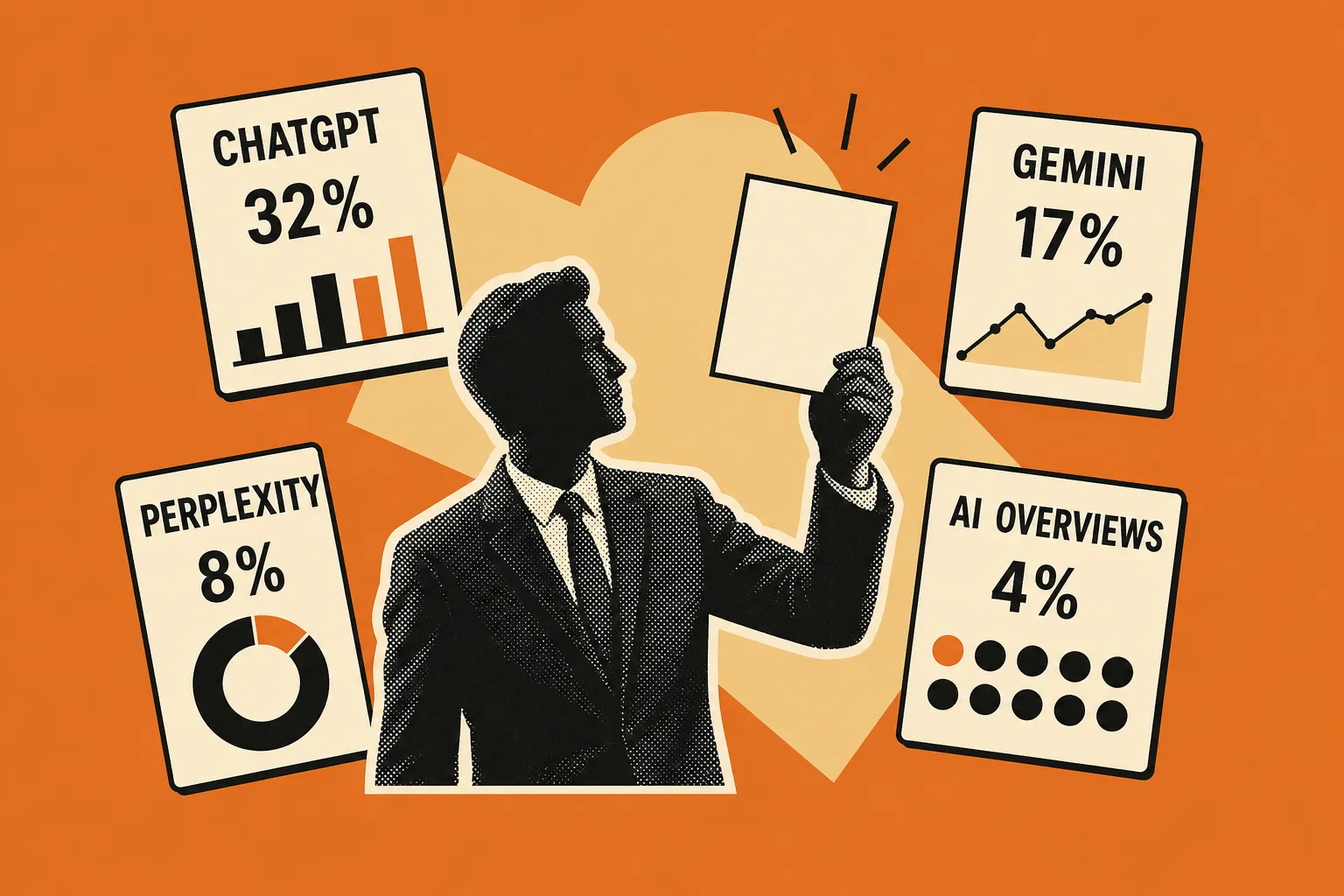
Platform matters too. Australian sites receiving any AI-referred traffic jumped from 13.5% in 2023 to 88.5% in 2025, an Optimising study of 115 Australian brands found, with ChatGPT driving 90.2% of identifiable AI visits, ahead of Perplexity at 4.25% and Gemini at 2.5% (agency client data to September 2025). Each system has its own sources and memory, which is why per-engine visibility is worth tracking. People cross-check, too: a US survey of 1,008 consumers by Fractl and Search Engine Land found they check an average of 2.4 platforms before a purchase decision. That is US consumer data, with no B2B, Australian or UK equivalent yet, so treat it as directional.
How AI assembles a vendor shortlist, and how to get on it
When a buyer asks for the "best X for Y", the AI recommendation list that comes back is synthesised from other pages. Google says AI Overviews and AI Mode may use a "query fan-out" technique, running related searches to gather supporting pages. Most evidence on source types comes from vendors selling AI-visibility or review products, so treat the order below as directional.
Third-party "best of" roundups lead. "Best X" lists made up 43.8% of the 26,283 source URLs behind ChatGPT's answers to 750 top-of-funnel prompts across software, products and agencies, according to Ahrefs. Wix's analysis of over a million AI citations across ChatGPT, AI Mode and Perplexity found listicles the most-cited page type, at 35.4% for SaaS; in professional services, 80.9% of listicle citations among top URLs were third-party. Find the roundups AI already cites in your category and earn a place in them: digital PR for AI search more than technical SEO.
Earned mentions build the underlying confidence. In Ahrefs' study of roughly 75,000 brands, branded web mentions (about 0.66 to 0.71) and YouTube mentions (about 0.74) correlated most strongly with AI visibility, while ad spend and backlinks fell below 0.30. That is correlation, as Ahrefs notes, but it favours earned mentions over links.
Review platforms matter most at evaluation, and estimates vary widely. In a G2-published study of about 35,000 ChatGPT citations for US software queries, review platforms' share rose from 7.4% at discovery to 13.2% at evaluation; a small agency test put review aggregators at 0.9%. Buyers still use them: G2's 2026 Buyer Behavior Report (1,038 decision-makers) found review sites (38%) and AI chatbots (37%) the top shortlist influences. Keep profiles current with genuine reviews, but don't chase volume: G2's own analysis found 10% more reviews were associated with only 2% more citations.
Community threads recur. Across 1,000 B2B buyer-intent queries, Growtika found Reddit cited in all 10 verticals, so useful participation on Reddit and industry forums belongs in the plan.
Directories and association listings are table stakes, on reasoning more than data. No study isolates them for B2B. In an Australian agency test of 2,400 AI responses in September 2026, the directory Starworks appeared 199 times, behind only Google and Reddit, but for trades and local services, so read it as "be listed where AI looks".
Your own comparison pages are a minor lever. In the Wix data, comparison pages drew 2.2% of citations and "alternatives" pages 0.29%; third-party comparison coverage inside roundups counts for more.
Your site is still where buyers verify you: in a Semrush survey of 519 AI-using US B2B professionals, 71% visited the vendor's website after an AI recommendation. Our view (reasoning, not proven cause) is that describing who you serve consistently across your site, LinkedIn and listings makes you easier for a model to place; the Search Engine Land travel analysis argues inconsistencies "can reduce confidence in your brand". No LLMS.txt file shortcuts this: Google's guide says such files "will neither harm nor help" Search visibility.
Why your brand isn't showing up when AI recommends vendors in your category
Before you conclude you're invisible, check. SparkToro found less than a 1-in-100 chance that ChatGPT or Google's AI, asked the same prompt 100 times, returns the same list of brands twice. So run each buyer prompt repeatedly and count how often you appear. If you're consistently absent, work through the likely causes.
1. You're missing from the sources AI draws on. Roughly 26% of brands in Ahrefs' AI Overview study had zero AI Overview mentions, and thin off-site mentions are the factor most associated with low visibility.
2. You're on the list but not chosen. LEOPRD's 2026 analysis of AI responses across Australia, the UK and the US found brands absent from 36% of unbranded category answers, mentioned but not preferred in 35%, and first choice in only 29%. (LEOPRD is an AI-visibility advisory firm; its method is only partly disclosed.)
3. Your category description is muddled. If your site and listings describe you differently, a model has less to anchor on. That is reasoning rather than research, but it is cheap to fix.
4. The platform or mode differs. As of 2025, Profound's citation analysis showed ChatGPT leaning on Wikipedia and Perplexity on Reddit, and Semrush found only 25% of cited sources overlap between ChatGPT's reasoning modes.
5. Google can't use the page. For AI Overviews and AI Mode, a page that isn't indexed or snippet-eligible can't be a supporting link.
Keep it in proportion: the models miss things too. Two-thirds of the Semrush respondents (66%) had spotted vendors missing from AI results. Amina's structural self-assessment walks through these checks.
Measuring it when the clicks fall
If AI recommends you without sending a click, your dashboard can show a decline while your visibility grows. The pressure is visible locally: some of Australia's largest news sites saw year-on-year organic search declines of as much as 35% since AI Overviews arrived, per an ABC analysis of SimilarWeb data reported by SmartCompany.
So change what you count. The Search Engine Land travel analysis suggests treating branded-search growth, AI mentions and citations, and assisted conversions (visible in GA4's conversion-path reports) as visibility signals. Google's generative AI performance reports in Search Console reached all websites worldwide by 31 August 2026 (see the Rundown on Search Console AI reports), but show impressions only, with no click or query data. Bing Webmaster Tools' AI Performance report, in public preview since February 2026, counts citations in Copilot and Bing's AI answers and samples the grounding queries behind them; since June 2026 it also groups those queries by intent and topic (a global preview). Neither report shows whether your brand was named in a list; that still takes repeated prompt testing, scored as an appearance rate, the logic behind tracking share of model.
Specialist tracking is now a funded category on both sides of this market. Sydney startup Hall raised $2 million pre-seed to monitor AI brand mentions and track how AI conversations translate into business outcomes, and has since been acquired by Tracksuit. In the UK, Searchable raised £3.1 million to show how LLMs interpret brands, with founder Chris Donnelly arguing that visibility "is earned by how AI interprets and prioritises your brand," then a further £10.3 million in May 2026.
A first-90-days plan when you're flying blind
None of this requires a big budget, just the right sequence.
Days 1 to 30: establish the baseline. Prompt ChatGPT, Perplexity and Google AI Mode with the questions a real buyer asks in your category, several times each, and record how often you appear, who else is named and which sources the answers lean on. Neil Patel's team recommends tracing each narrative back to its sources. Switch on the Search Console and Bing AI reports, and audit how your site, LinkedIn and listings describe you.
Days 31 to 60: get onto the lists. Work the roundups, review platforms, threads and directories your baseline surfaced: pitch for inclusion in third-party "best of" articles, refresh review profiles with genuine reviews, join the conversations about your category, and reconcile conflicting descriptions. This is slow, compounding work.
Days 61 to 90: measure and set a cadence. Rerun the baseline, track appearance rate alongside branded search and assisted conversions, and make monitoring monthly, since AI outputs shift as the web shifts. A brand that checks monthly will catch a hardening narrative while it's still soft.
Key takeaways
• AI chatbots answer vendor questions with a short list built for the person asking, so the job is to be on that list when the right buyer asks.
• Third-party "best of" roundups are the most-cited source for these lists; earned mentions, community threads and, at evaluation, review platforms also feed in. Your own comparison pages barely register.
• Lists are unstable and personalised, so test each prompt repeatedly and measure how often you appear rather than where.
• Search Console (impressions) and Bing (citations) now report AI performance, but only repeated testing or trackers such as Hall (now part of Tracksuit) and Searchable show whether you were named.
• Run a 90-day arc: baseline, get onto the lists, then monitor monthly.
Frequently asked questions
How can a brand get onto the list when B2B buyers ask AI to find vendors?
Get named in the sources AI builds those lists from. Ahrefs and Wix studies find "best of" list articles are the most-cited page type in AI answers about vendors and products, and in Wix's professional-services data about four in five of those cited lists were third-party, with earned media, community threads and, at the evaluation stage, review platforms also feeding in.
Why isn't my brand showing up when AI chatbots recommend vendors in my category?
The likeliest gap is thin presence in the third-party sources AI cites, especially category roundups (off-site mentions are the factor most associated with AI visibility in Ahrefs' 75,000-brand study). First confirm you are really absent: SparkToro found less than a 1-in-100 chance of getting the same brand list twice, so run each prompt several times. Platform differences, a muddled category description and pages Google cannot index can also play a part.
What helps a B2B brand understand buyer intent and visibility in AI search?
A mix of platform reports, specialist tools and manual testing. Bing Webmaster Tools' AI Performance report shows citations in Copilot and Bing answers and samples the grounding queries behind them, grouped by intent and topic since June 2026 (a global preview). Search Console's generative AI report shows impressions in AI Overviews and AI Mode, but no query data. Trackers such as Hall (now part of Tracksuit) or Searchable monitor brand mentions, and repeated prompt testing shows whether you are named. Amina's free AI-visibility check offers a one-off baseline.
Is AI search visibility, or GEO, a separate discipline from SEO?
This is not settled. Google says optimising for generative AI search is "still SEO" and that no special optimisations are needed to appear in AI Overviews or AI Mode. The signals that help overlap heavily with strong SEO, so treat GEO as an emphasis rather than a separate rulebook.
Are B2B buyers really using AI to research vendors?
Increasingly, yes. A March 2026 G2 survey of 1,076 B2B software decision-makers found 51% now start research with an AI chatbot more often than with Google, up from 29% in April 2025. That pool is global, but Gartner's 2026 survey reports about 97% of Australian technology buyers use AI tools or agentic AI in the buying journey.
About Amina
Not sure what ChatGPT, Perplexity or Google AI Mode say when a buyer asks for vendors in your category? Amina's AI-visibility service measures how often your brand is named across the major AI assistants and closes the gap, so you are built to be found when a buyer asks AI about your field.